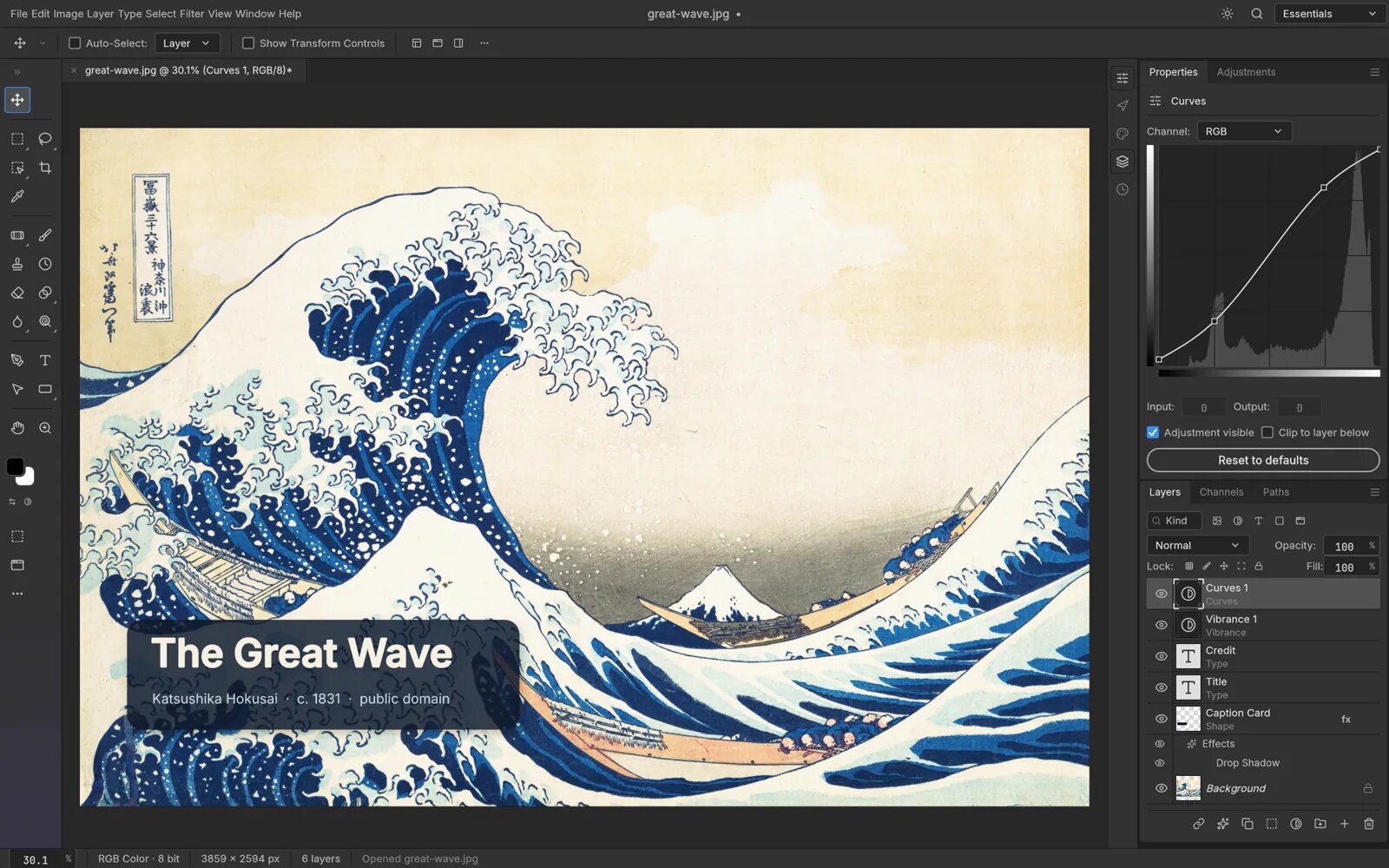
On 30 September, a small team made the first commit to a project called PhotoCraft. A free, open source version of Photoshop.
By 11 October there were 12 apps. Photoshop, Lightroom, Premiere, Illustrator, After Effects, InDesign and Acrobat. Then, because why stop there, Word, Excel, PowerPoint, AutoCAD and Pro Tools.
I went and looked at the numbers myself. In those twelve days the project made 12,601 commits. A commit is a saved change to the code, each one a described, deliberate piece of work. On 10 October alone there were 2,565 of them, more than 100 an hour. And it doesn't stop at night. There are commits in every hour of every day. Roughly three quarters were written by AI agents, mostly Claude, working in parallel. The result so far is close to 3 million lines of code.
The person behind it, Brandon Thomas, put it bluntly on Hacker News: "Software is over. But for real."
It isn't finished, and they're refreshingly honest about that. At the time of writing, PhotoCraft rates itself about 45% ready for real work. Every menu is wired up, but much of what sits behind them isn't deep enough yet. By the time you read this, that number will have moved. Their roadmap estimates a few thousand more hours of agent time to reach about 95%. With a handful of agents running side by side, that's a matter of weeks.
And it already feels familiar. It looks like Photoshop and uses the same keyboard shortcuts. It even opens and saves Photoshop files. If you've used Photoshop, you can sit down and get going.
I don't think software is over. But I do think we've reached the point where the software is no longer the product. Everything around it is.
Is this even allowed?
I'm not a lawyer, and I'm sure this will keep plenty of them busy. But it isn't a new question.
In the early nineties Borland built a spreadsheet that copied the menus of Lotus 1-2-3, the spreadsheet everyone used at the time, so people could switch without relearning anything. Lotus sued. The court said a menu is a "method of operation", like the buttons on a video recorder, and you can't copyright that. A quarter of a century later Google rebuilt Oracle's Java programming interfaces from scratch, and the US Supreme Court called it fair use.
So copying how something looks and behaves is, broadly, on firm ground. Copying the code is not. That's why PhotoCraft calls itself a "clean room" build. Its rules tell the agents to study Photoshop from the outside and never touch its code.
What is new is the AI in the middle. A clean room only works if the people building it have never seen the original code. A model that has read most of the code on the internet is a very different kind of builder. Part of Photoshop's source was stolen from Adobe in 2013 and briefly posted online. Could any of it have ended up in a model's training data? Nobody can say, and from the outside nobody can really check. The tools that spot copied code need both versions to compare, and only Adobe has its own. No court has ruled on whether an AI can be a clean room. I suspect one will have to.
Familiar on the outside
The more I looked, the less this felt like copying. They keep the part people already know and rebuild everything underneath for the way we work now.
Think about electric cars. Underneath, an electric car has almost nothing in common with a petrol one. But you still get a steering wheel and two pedals, because that's what drivers know. Nobody had to learn to drive again.
That's what's going on here. They run on Windows, macOS and Linux (Adobe has never supported Linux), and in a web browser. They're open source, so anyone can adapt one to the way they work. No subscription, and your files stay on your own machine.
And they were built for AI agents from the first line. Everything in PhotoCraft is one of more than 500 commands, and in the project's own words, "anything you can click, a script or an AI agent can do too." To be fair, Adobe is heading the same way. You can now drive Photoshop from inside ChatGPT and Claude. But that's a 36 year old application being taught to take instructions. These were born taking them.
What happens to a company of 31,000 people?
Adobe's last quarter was its best ever, nearly $6.8 billion in revenue. Yet its share price is down about 31% this year and its CEO steps down in December. Investors can see something coming that the accounts don't show yet.
I spent most of my career on the vendor side, and if I learnt one thing, it's that customers rarely buy the software. They buy confidence. That it'll work, that someone will answer when it doesn't, that the files will still open in ten years, that the staff already know it, that their own legal team is happy with the contract. Adobe has all of that, and decades of trust on top. None of it lives in the code, and none of it was cloned in twelve days.
What was cloned is the features, and the features are what justify the price. Once anyone can make a decent copy in a fortnight, it gets very hard to charge a premium for them.
Look at how the clones pay their way. The apps are free. The company behind them sells credits for AI image and video generation. The software is the marketing.
If I were starting today
I'd stop thinking of the software as the thing I sell, and put my energy into what's hard to copy. Data that only I have. People who'd stay with me if my code were cloned tomorrow. Taste, knowing what to build and what to leave out. Trust, which takes years and can't be copied over a weekend. And I'd charge for what the tool gets done for people.
Earlier this year I wrote about building my own software for my art, with AI doing a lot of the heavy lifting. I didn't build it because I wanted to write software. I built it because the tool I needed didn't exist. Looking back, the code was never the interesting part. The interesting part was deciding what the tool should do, and then what to make with it.
That's where the creativity lives, and it stays with you. It comes from where you've been and what you care about. No agent has lived your life. And to be honest, that's the fun part. Most of us want to be making things, not making the tools to make things.
AI doesn't take that away. If anything it hands it back. You can now be part of building tools that simply weren't possible before, shaped around an idea only you had. But the innovation isn't in the typing. It never really was.
Something big is happening here, at a speed we're not used to as humans and at a scale I've never seen before. Some days I find it hard to reconcile the pros and cons of it all. I'm sure many of you feel the same way.
I'd love to hear from both sides of this. If you build software, how are you thinking about it? And if you buy it, would a free version that's most of the way there change what you're willing to pay for the real thing?
Mac